Featured — Page 88
KENNEDY SPACE CENTER, FLA. - In the Space Station Processing Facility, technicians begin pre-assembly measurements on the Japanese Experiment Module (JEM). Developed by the Japan Aerospace Exploration Agency (JAXA), the JEM will enhance the unique research capabilities of the orbiting complex by providing an additional environment for astronauts to conduct science experiments.

KENNEDY SPACE CENTER, FLA. - In the Space Station Processing Facility, STS-117 Mission Specialist James Reilly stands in front of the Japanese Experiment Module (JEM). Reilly and STS-115 Mission Specialist Joseph Tanner are at KSC for equipment familiarization, a routine part of astronaut training and launch preparations.
Open

KENNEDY SPACE CENTER, FLA. - Seen from below and through a solid rocket booster segment mockup, Jeff Thon, an SRB mechanic with United Space Alliance, tests the feasibility of a vertical solid rocket booster propellant grain inspection technique. The inspection of segments is required as part of safety analysis.
Open

KENNEDY SPACE CENTER, FLA. - In the Space Station Processing Facility, technicians take readings for pre-assembly measurements on the Japanese Experiment Module (JEM). Developed by the Japan Aerospace Exploration Agency (JAXA), the JEM will enhance the unique research capabilities of the orbiting complex by providing an additional environment for astronauts to conduct science experiments.
Open

KENNEDY SPACE CENTER, FLA. - KSC employees fill the Training Auditorium to hear comments from Expedition 6 Commander Ken Bowersox about his mission and residence on the International Space Station from November 25, 2002, to May 3, 2003.
Open

KENNEDY SPACE CENTER, FLA. - In the Space Station Processing Facility, Executive Director of NASDA Koji Yamamoto (center) gets information about the facility while on a tour of KSC. Behind the group is the Japanese Experiment Module (JEM)/pressurized module. Mr. Yamamoto is at KSC for a welcome ceremony involving the arrival of JEM.
Open

KENNEDY SPACE CENTER, FLA. - On Launch Complex 17-B, Cape Canaveral Air Force Station, the Space Infrared Telescope Facility (SIRTF) observatory is lowered to the ground and taken back to NASA Spacecraft Hangar AE. SIRTF will remain in the clean room at Hangar AE until it returns to the pad in early August.
Open

KENNEDY SPACE CENTER, FLA. - In the Space Station Processing Facility, STS-117 Mission Specialist James Reilly works with the Japanese Experiment Module (JEM). Reilly and STS-115 Mission Specialist Joseph Tanner are at KSC for equipment familiarization, a routine part of astronaut training and launch preparations.
Open

KENNEDY SPACE CENTER, FLA. - Shuttle Launch Director Mike Leinbach (left) accompanies Executive Director of NASDA Koji Yamamoto (third from left) and others visiting the Columbia Debris Hangar. Mr. Yamamoto is at KSC for a welcome ceremony involving the arrival of the newest Space Station module, the Japanese Experiment Module/pressurized module.
Open

KENNEDY SPACE CENTER, FLA. - In the Space Station Processing Facility, STS-115 Mission Specialist Joseph Tanner (left) and STS-117 Mission Specialist James Reilly (right) are donning protective clothing to interface with the Japanese Experiment Module (JEM), in the background. Equipment familiarization is a routine part of astronaut training and launch preparations.
Open

KENNEDY SPACE CENTER, FLA. - In the Space Station Processing Facility, Executive Director of NASDA Koji Yamamoto (left) looks at the newly arrived Japanese Experiment Module (JEM)/pressurized module. Mr. Yamamoto is at KSC for a welcome ceremony involving the arrival of JEM.
Open

KENNEDY SPACE CENTER, FLA. - Workers in KSC's Vertical Processing Facility stow cable and adapters into a protective enclosure for the second Hubble Space Telescope servicing mission, STS-82. Liftoff aboard Discovery is targeted Feb. 11 with a crew of seven.
Open

KENNEDY SPACE CENTER, FLA. - In the Orbiter Processing Facility, Dan Clark, with KSC Boeing, operates the camera for a 3D digital scan of the actuator on the table. There are two actuators per engine on the Shuttle, one for pitch motion and one for yaw motion. The Space Shuttle Main Engine hydraulic servoactuators are used to gimbal the main engine.
Open

KENNEDY SPACE CENTER, FLA. - In the Orbiter Processing Facility, KSC employee Gene Peavler works in the wheel area on the orbiter Discovery. The vehicle has undergone Orbiter Major Modifications in the past year. Discovery is scheduled to fly on mission STS-121 to the International Space Station.
Open

KENNEDY SPACE CENTER, FLA. - A replica of a Space Shuttle orbiter is on exhibit outside the Astronaut Hall of Fame, which features the world’s largest collection of personal astronaut mementos plus historic spacecrafts and training simulators. The Hall of Fame is part of the KSC Visitor Complex.
Open

KENNEDY SPACE CENTER, FLA. - In the Space Station Processing Facility, STS-114 Pilot James Kelly (left) and Commander Eileen Collins look at various equipment housed there. The STS-114 crew is at KSC to take part in crew equipment and orbiter familiarization.
Open

KENNEDY SPACE CENTER, FLA. - In the Space Station Processing Facility, a technician takes readings for pre-assembly measurements on the Japanese Experiment Module (JEM). Developed by the Japan Aerospace Exploration Agency (JAXA), the JEM will enhance the unique research capabilities of the orbiting complex by providing an additional environment for astronauts to conduct science experiments.
Open

KENNEDY SPACE CENTER, FLA. - In the Space Station Processing Facility, STS-114 Mission Specialist Wendy Lawrence manipulates part of a Multi-Purpose Logistics Module. Lawrence is a new addition to the mission crew. The STS-114 crew is at KSC to take part in crew equipment and orbiter familiarization.
Open

KENNEDY SPACE CENTER, FLA. - In the Space Station Processing Facility, workers (in protective clothing) brief STS-117 Mission Specialist James Reilly (center) and STS-115 Mission Specialist Joseph Tanner (right) about the Japanese Experiment Module (JEM). Equipment familiarization is a routine part of astronaut training and launch preparations.
Open

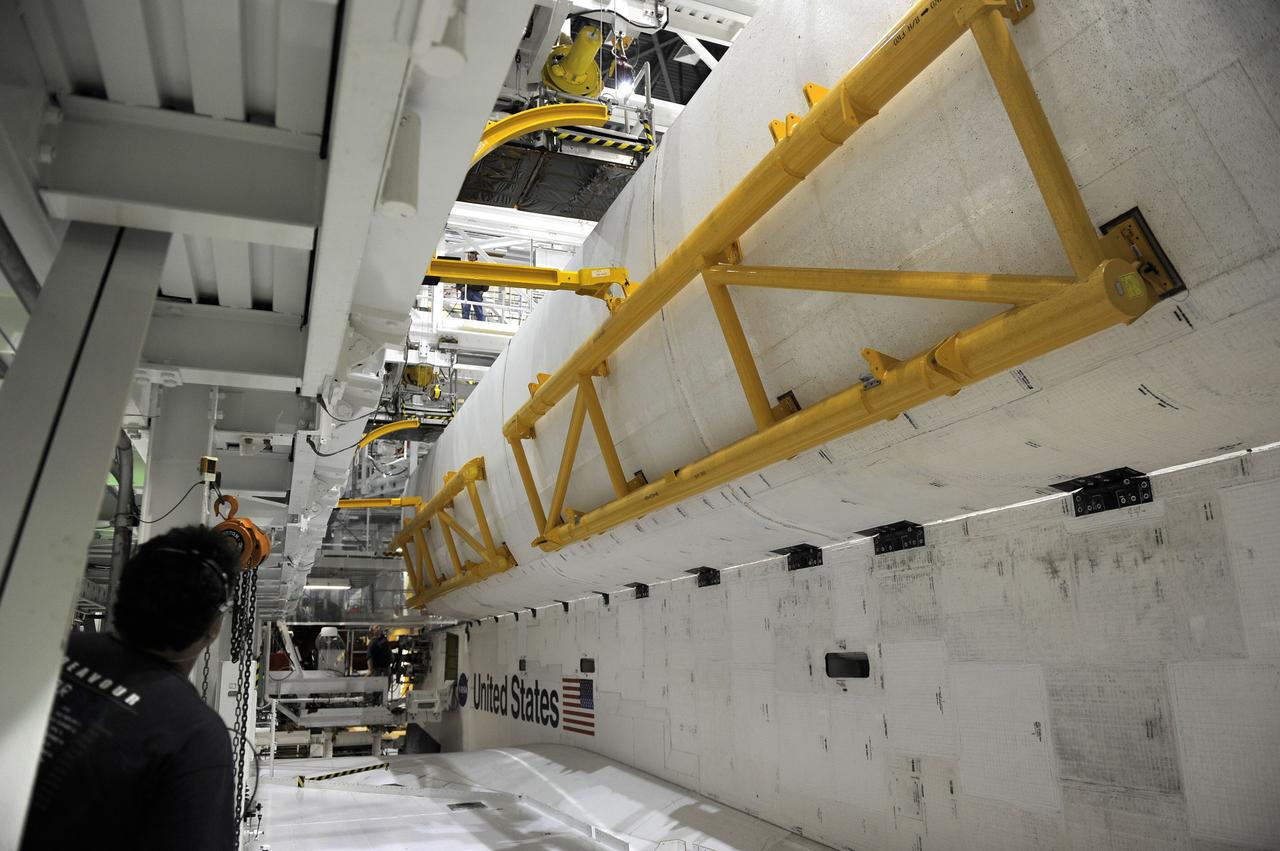
KENNEDY SPACE CENTER, FLA. - One of the featured displays at the KSC Visitor Complex is the genuine external tank (center) with twin solid rocket boosters, seen here at the lower end. The tank and boosters are paired with a full-size replica of a Space Shuttle Orbiter in the Shuttle Plaza.
Open

KENNEDY SPACE CENTER, FLA. - In the Solid Rocket Booster Assembly and Refurbishment Facility (ARF), Vernon Gibbs, with United Space Alliance, prepares the forward skirt of a solid rocket booster for installation of the parachute camera. Refurbishment and subassembly of Shuttle SRB hardware - primarily the forward and aft assemblies - is carried out in the ARF.
Open

KENNEDY SPACE CENTER, FLA. - Jeff Thon, an SRB mechanic with United Space Alliance, is fitted with a harness to test a vertical solid rocket booster propellant grain inspection technique. Thon will be lowered inside a mockup of two segments of the SRBs. The inspection of segments is required as part of safety analysis.
Open

KENNEDY SPACE CENTER, FLA. - In the Solid Rocket Booster Assembly and Refurbishment Facility (ARF), Troy Krout, with United Space Alliance, works on positioning the parachute camera after installation on the solid rocket booster forward skirt. Refurbishment and subassembly of Shuttle SRB hardware - primarily the forward and aft assemblies - is carried out in the ARF.
Open

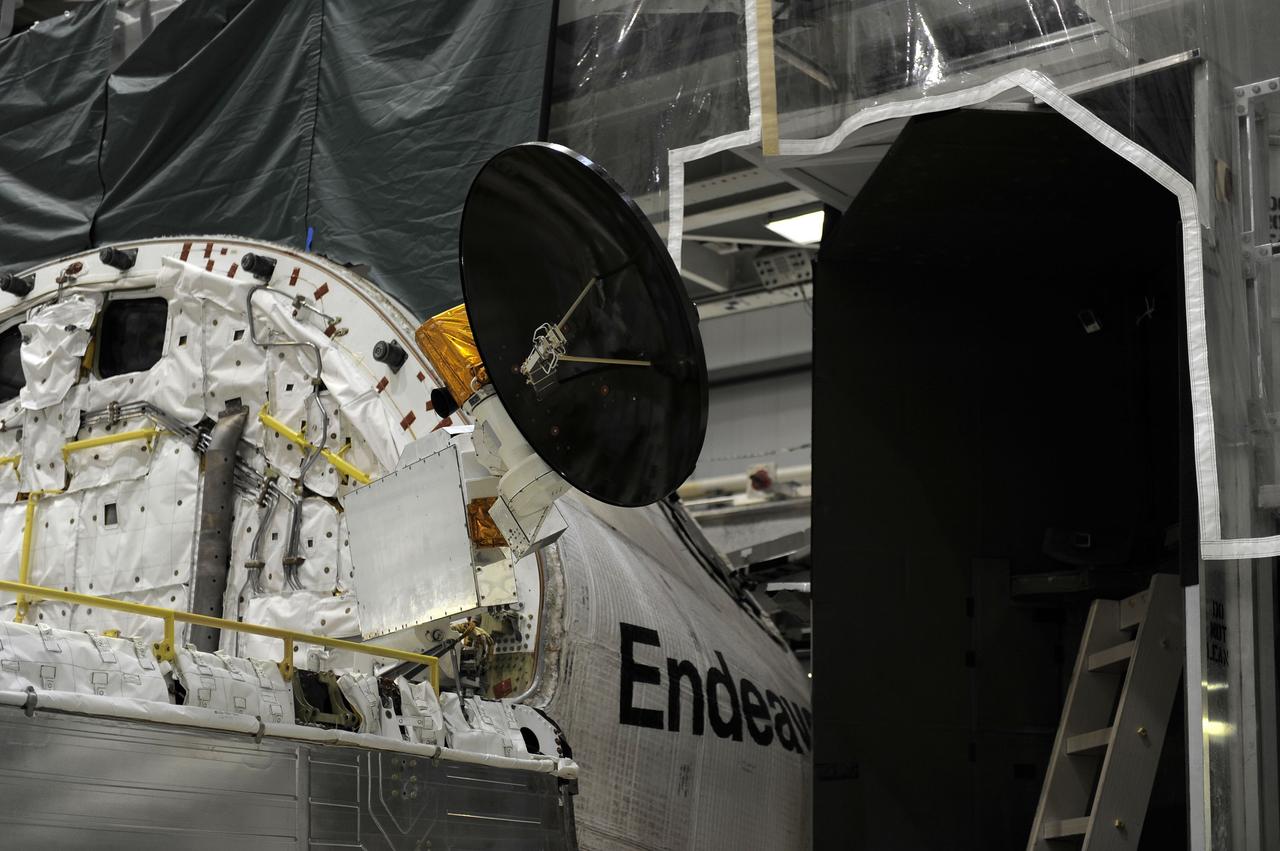
KENNEDY SPACE CENTER, FLA. - In the Orbiter Processing Facility, while Greg Harlow, with United Space Alliance (USA), (above) threads a camera under the tiles of the orbiter Endeavour, NASA’s Richard Parker (below left) and Peggy Ritchie, with USA, (at right) watch the images on a monitor to inspect for corrosion.
Open

KENNEDY SPACE CENTER, FLA. - In the Space Station Processing Facility, a technician takes readings for pre-assembly measurements on the Japanese Experiment Module (JEM). Developed by the Japan Aerospace Exploration Agency (JAXA), the JEM will enhance the unique research capabilities of the orbiting complex by providing an additional environment for astronauts to conduct science experiments.
Open